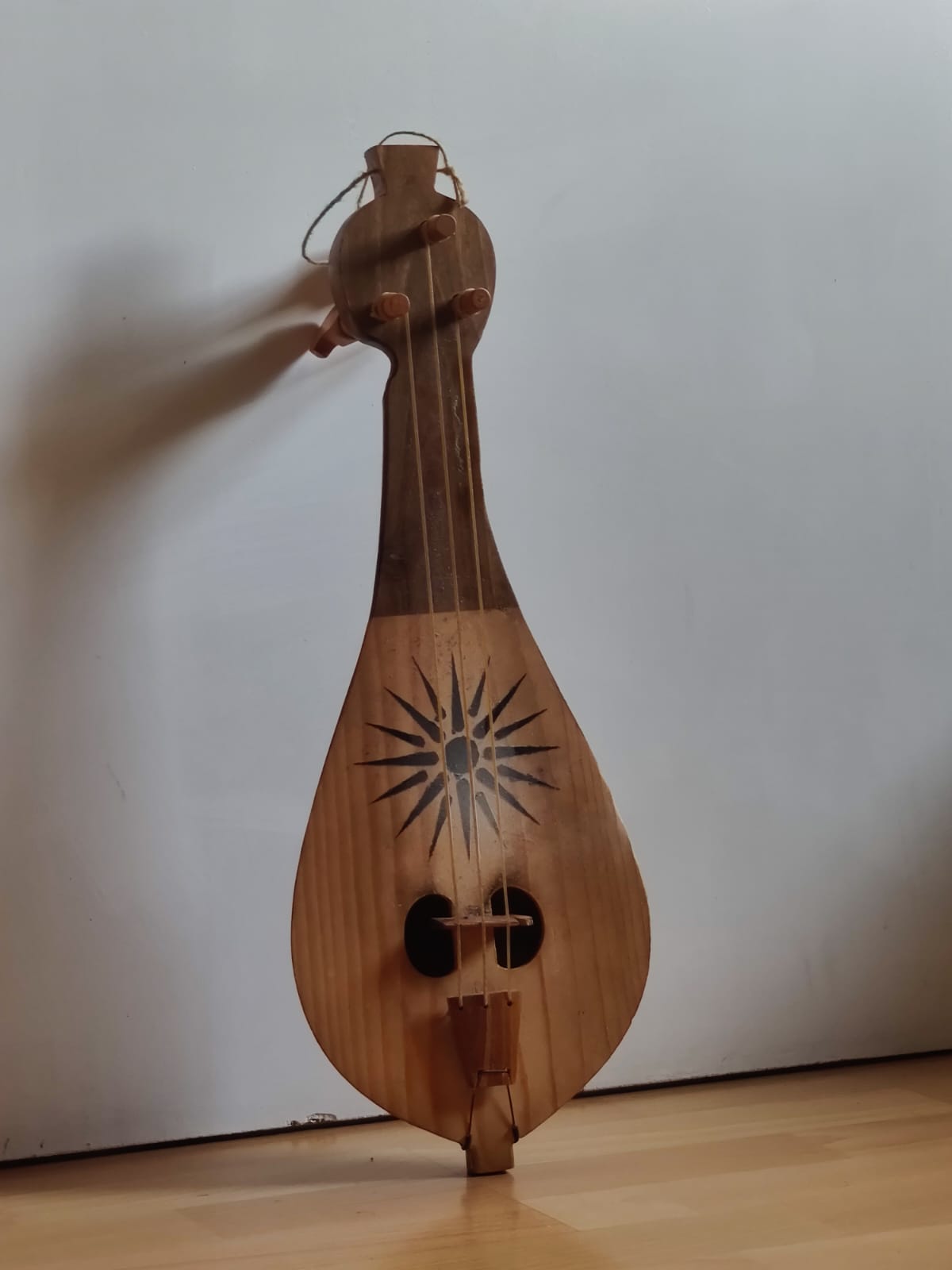
Maker of the lyra in the photograph: Thodoros Glavas, 2017.
Περιγραφή / Description
Ελληνικά
Η μακεδονική λύρα είναι ένα παραδοσιακό έγχορδο μουσικό όργανο με δοξάρι, το οποίο παίζεται κυρίως στα χωριά της περιοχής της Δράμας στη Βόρεια Ελλάδα. Διαθέτει τρεις χορδές και στη μουσική της λειτουργία είναι εμπνευσμένη από την παραδοσιακή γκάϊντα. Χαρακτηριστικό στοιχείο της είναι ο τρόπος παιξίματος, όπου ηχούν πάντοτε δύο χορδές ταυτόχρονα: η μεσαία χορδή παίζεται συνεχώς και κρατά έναν βασικό φθόγγο (ισοκράτημα), αντίστοιχο με τον ντρόνο της γκάϊντας.
Ανάλογα με τη μελωδική πορεία, παίζονται οι συνδυασμοί χορδών 1 + 2 ή 2 + 3, δημιουργώντας τον χαρακτηριστικό, αρχαϊκό ήχο της μακεδονικής λύρας, ο οποίος θυμίζει έντονα τη δομή των παραδοσιακών πνευστών με ισοκράτημα.
Τεχνική παιξίματος και δακτυλισμός
Μια ιδιαίτερη πτυχή του οργάνου αφορά την τεχνική του αριστερού χεριού:
- Χορδή 1 (αριστερά στην εικόνα): Πιέζεται με τα δάχτυλα και χρησιμοποιούνται αποκλειστικά η ανοιχτή χορδή, ο πρώτος και ο δεύτερος δάχτυλος. Σε αντίθεση με το βιολί, όπου χρησιμοποιείται και ο τέταρτος δάχτυλος, το φωνητικό εύρος εδώ είναι σκόπιμα περιορισμένο.
- Χορδή 2 (μεσαία): Λειτουργεί ως ισοκράτης και παίζεται μόνο με το δοξάρι. Δεν πιέζεται με τα δάχτυλα και διατηρεί συνεχώς τον βασικό φθόγγο.
- Χορδή 3 (δεξιά στην εικόνα): Πιέζεται πλάγια με τα νύχια, παρόμοια με την κρητική λύρα. Μπορεί να παιχτεί από την ανοιχτή χορδή έως τον τέταρτο δάχτυλο και ακόμη λίγο πιο χαμηλά.
Έκταση και κούρδισμα
Στο κανονικό παίξιμο έως τον τέταρτο δάχτυλο,
το όργανο καλύπτει περίπου μία οκτάβα.
Με ελαφριά «ολίσθηση» του τέταρτου δαχτύλου,
η έκταση μπορεί να επεκταθεί σε περίπου 9–10 φθόγγους.
Το κούρδισμα της μακεδονικής λύρας δεν είναι τυποποιημένο και διαφέρει ανάλογα με το όργανο, τον εκτελεστή και την τοπική παράδοση. Συχνά, ιδιαίτερα σε ανδρικές φωνές, χρησιμοποιείται το εξής βασικό κούρδισμα: χορδή 1 σε d¹ (ρε), χορδή 2 σε g (σολ) και χορδή 3 σε g¹ (σολ). Οι χορδές 2 και 3 είναι κουρδισμένες στον ίδιο φθόγγο, με τη χορδή 2 να ηχεί μία οκτάβα χαμηλότερα, σύμφωνα με την αρχή του ισοκρατήματος.
Το κούρδισμα μπορεί να μεταβληθεί κατά ημιτόνια ή ολόκληρους τόνους, ανάλογα με τη φωνητική έκταση ή το προσωπικό ύφος του εκτελεστή. Συνηθισμένα εναλλακτικά κουρδίσματα είναι:
- cis¹ – fis – fis¹ (ρε♯ – φα♯ – φα♯)
- d¹ – g – g¹ (ρε – σολ – σολ)
- dis¹ – gis – gis¹ (ρε♯ – σολ♯ – σολ♯)
- e¹ – a – a¹ (μι – λα – λα)
- f¹ – ais – ais¹ (φα – λα♯ – λα♯)
English
The Macedonian lyra is a traditional bowed string instrument primarily found in the villages of the Drama region in Northern Greece. It has three strings and is functionally inspired by the traditional bagpipe (gaida). A defining characteristic of the instrument is its playing technique, in which two strings are always sounded simultaneously: the middle string is continuously bowed and maintains a sustained drone (isokratima), similar to the drone of the bagpipe.
Depending on the melodic movement, either string pairs 1 + 2 or 2 + 3 are played together, creating the distinctive, archaic sound of the Macedonian lyra, closely related to the drone-based structure of traditional wind instruments.
Playing technique and fingering
A notable feature of the instrument concerns the left-hand technique:
- String 1 (left in the image): This string is stopped with the fingers, using only the open string, first and second finger. Unlike the violin, where the fourth finger is commonly used, the tonal range here is deliberately limited.
- String 2 (middle string): This string functions as a drone and is played exclusively with the bow. It is not stopped and continuously sustains the fundamental pitch.
- String 3 (right in the image): This string is stopped sideways using the fingernails, similar to the technique of the Cretan lyra. It can be played from the open string up to the fourth finger and slightly beyond.
Range and tuning
Within the regular playing position up to the fourth finger,
the instrument covers approximately one octave.
By slightly sliding the fourth finger,
the range can be extended to around 9–10 pitches.
The tuning of the Macedonian lyra is individual and not standardized. It varies according to the instrument, the performer, and regional tradition. For male singers and players, a commonly used basic tuning is: string 1 tuned to d¹ (re), string 2 to g (sol), and string 3 to g¹ (sol). Strings 2 and 3 are tuned to the same pitch, with string 2 sounding one octave lower, following the principle of the drone (isokratima).
The tuning may be raised or lowered by semitones or whole tones, depending on vocal range or personal style. Common alternative tunings include:
- cis¹ – fis – fis¹ (re♯ – fa♯ – fa♯)
- d¹ – g – g¹ (re – sol – sol)
- dis¹ – gis – gis¹ (re♯ – sol♯ – sol♯)
- e¹ – a – a¹ (mi – la – la)
- f¹ – ais – ais¹ (fa – la♯ – la♯)